
Regional Pulse
Regional Pulse · 180 Days for the Dominican State's AI
The Dominican Republic made AI ethics mandatory for the entire State. Decree 787-26, approved on Tuesday the 3rd, bans social scoring, mass biometrics without a court order and automated criminal sentencing. Systems that affect rights or social benefits need an approved impact assessment before going live, and citizens gain the right to know when AI touched their case and to ask for human review.
Ethics Comes In Through Procurement
The week's regulatory decisions in Central America and the Caribbean, in five minutes.
The Dominican Republic made AI ethics mandatory for the entire State. Decree 787-26, approved on Tuesday the 3rd, bans social scoring, mass biometrics without a court order and automated criminal sentencing. Systems that affect rights or social benefits need an approved impact assessment before going live, and citizens gain the right to know when AI touched their case and to ask for human review.
What interests me most is that every institution must demand traceability, cybersecurity and control of the data from its vendors, with no black boxes the State cannot audit. That turns ethics into a procurement rule that applies to everyone regardless of where the vendor comes from. It is a decree and not a law, and 180 days is short for an inventory; the system registry is the first thing that should show up.
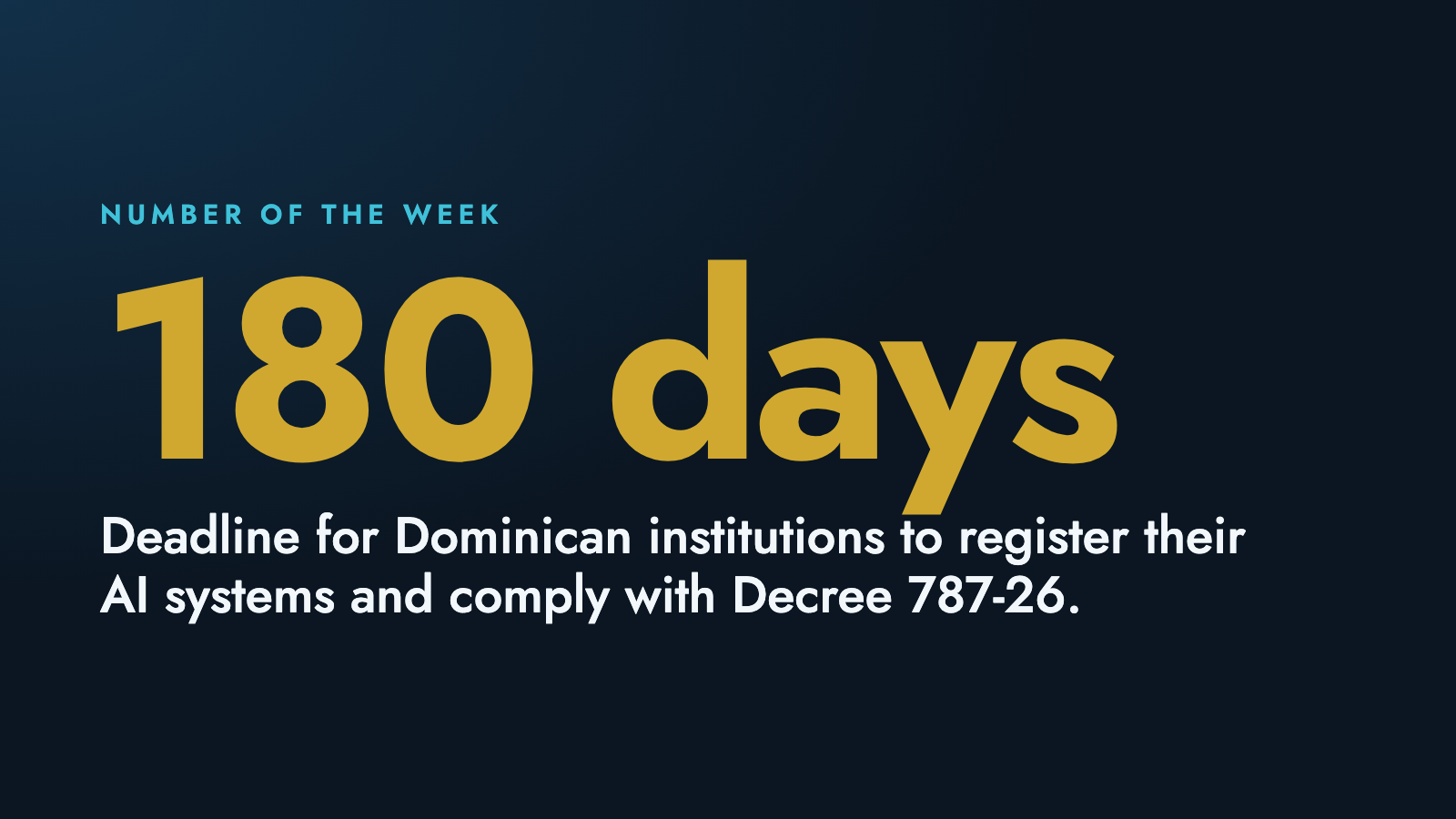
180 days is the deadline for Dominican institutions to register their AI systems and comply with Decree 787-26.
From the Factory Floor to Congress
Node-RED, common in industrial and IoT equipment, has a CVSS 10 flaw already under exploitation: VulnCheck saw the first attack on October 30 and 15 more in two days. If you have one exposed without authentication, close it today.
Anatel unanimously approved a public directory of short codes for business SMS, each tied to a single company, and the blocking of unregistered ones within 90 days. Any regulator in the region can copy it.
In Madrid the Ibero-American AI Alliance was born, with 22 countries at the table and a federated data space; what a small country puts in and gets back is still unclear.
Guatemala passed its Cybersecurity Law with 121 votes, but as of Saturday the 7th there is no signature or publication, and the 18 months for the CRIC-GT count from entry into force: the clock is not running yet.

Ask for the Live Test
In Bad Blood, John Carreyrou tells how at Walgreens Kevin Hunter asked to see the lab, a live test and an observer inside Theranos; he was denied everything and pushed out of the meetings. The Dominican rule does exactly what Walgreens didn't: assess before production and require vendors that allow audits. Same with a client: ask for the live test before you sign.


Before the Committee
On Corplife360 I published Preparing for the Committee Meeting, starting from what the decision-maker needs. And on my site, The United Nations Convention against Cybercrime.
Three Reads for Sunday
Kurt Meyer, Anette Mikes and Robert Kaplan explain in HBR how Swissgrid lets any employee report a risk in under a minute, even anonymously. That is how the region's response centers should work.
Veeral Desai, Tim Fountaine and Kayvaun Rowshankish propose in Harvard Business Review, in "A Better Way to Put Your Data to Work", treating data as a reusable product.
And Ethan Mollick, in his piece on AI's tipping point, makes the case for work where the expert guides and corrects the machine, the basis of the human review the Dominican decree requires.

What November Brings
From Monday the 9th to Friday the 27th, Doha elects the 2027-2030 leadership at the ITU's PP-26, and two candidates from the Americas compete for Deputy Secretary-General: Carlos Baigorri, from Brazil, and Stephen Bereaux, from the Bahamas. From Tuesday the 17th to Friday the 20th comes CyberWeek@LAC4 in Santo Domingo.
Indotel opened technical roundtables to replace the 1998 telecom law, Honduras closes its spectrum auction in December and Guatemala awaits the signing of its law.
Your Turn
Forward it to someone who buys or regulates technology. And tell me: is State AI better governed by a decree and procurement rules or by a law passed by Congress?