
Regional Pulse
Regional Pulse · 30 minutes: the clock Guatemala just set for its critical infrastructure
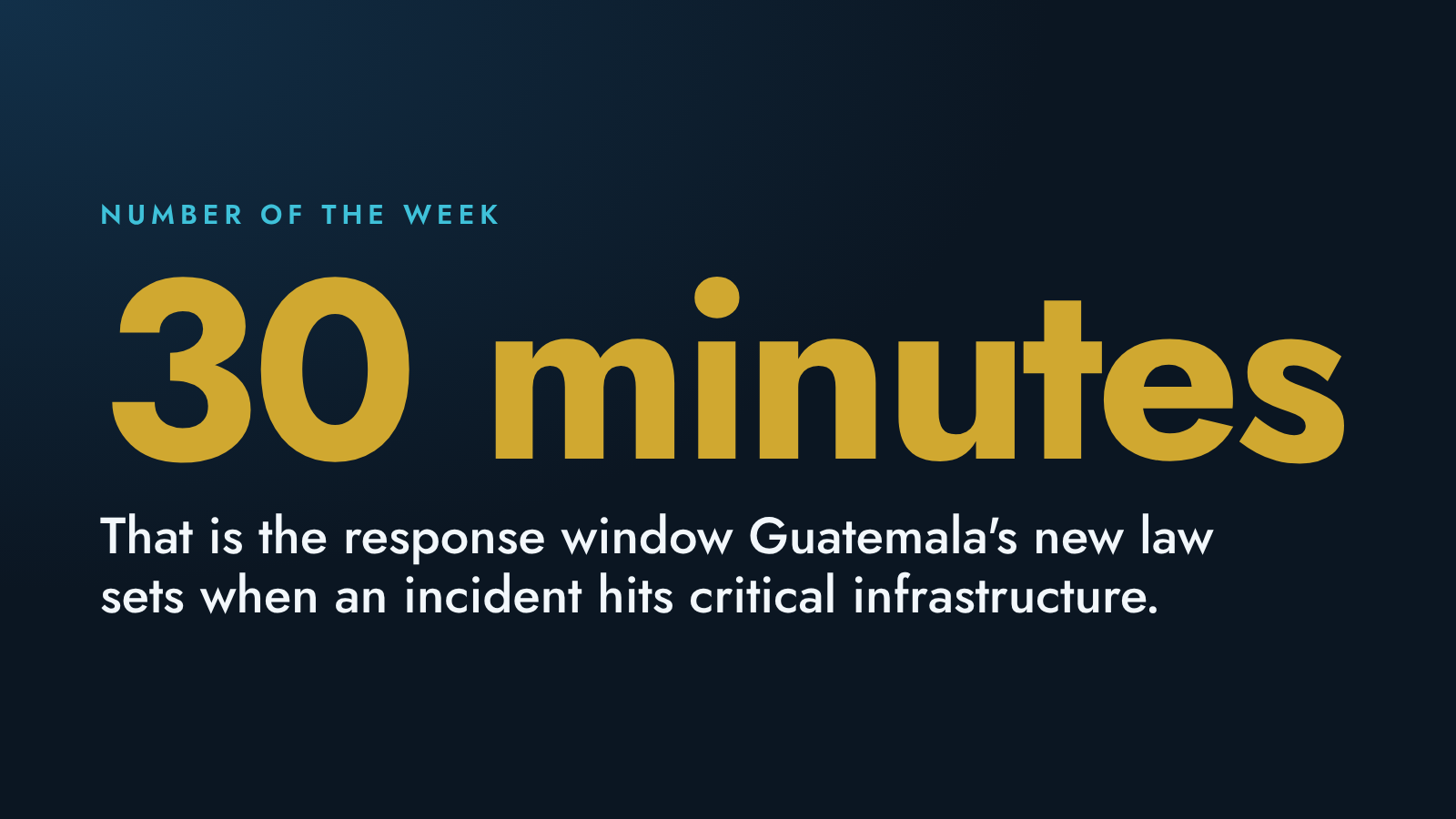
On Tuesday, November 17, Decree 26-2026 was published: the country's Framework Law on Cybersecurity, which creates a National Council, a specialized prosecutor's office and CRIC-GT, the national incident response center. It takes effect on Thursday, December 17, with fines of up to Q300,000. According to DPL News, it gives 30 minutes to respond when critical infrastructure is compromised and 72 hours to deliver the full assessment.
Guatemala has its law, and the hard part starts now
Here are the week's regulatory decisions in Central America and the Caribbean, in 5 minutes. This week belongs to Guatemala.
On Tuesday, November 17, Decree 26-2026 was published: the country's Framework Law on Cybersecurity, which creates a National Council, a specialized prosecutor's office and CRIC-GT, the national incident response center. It takes effect on Thursday, December 17, with fines of up to Q300,000. According to DPL News, it gives 30 minutes to respond when critical infrastructure is compromised and 72 hours to deliver the full assessment.
But the part that weighs most is still unwritten. What counts as an essential service will be defined in regulations that the Ministry of the Interior has six months to issue. If you run networks or banking there, I would show up at that table with concrete proposals and technical criteria.

Four quick moves
The Dominican Republic stopped 780 million cyberattacks through the end of October, according to the CNCS. Another figure in the same story tells me more: taking down a fake portal went from a week or longer to about two hours.
Caribbean Airlines told its customers that a third party reached booking data through a compromised account at an outside vendor. Your risk reaches as far as your suppliers do.
Indotel signed the contracts for 260 MHz with Viettel and Claro, worth about US$119.5 million, and the Dominican market gains a fourth operator.
Panama is moving more slowly: ASEP wants to understand first why nobody bid in the tender for a third mobile operator. Asking before calling a new tender helps you learn which design attracts an entrant.

Same case, two answers
In Noise, Kahneman, Sibony and Sunstein tell how executives at an insurance company expected a 10% difference between two underwriters looking at the same case. The audit found 55%. "Wherever there is judgment, there is noise, and more of it than you think."
It fits Guatemala perfectly. If the regulations leave no written criteria, two inspectors can treat the same incident differently. With a regulator, a client or your own team, ask for the criteria in writing before the first case arrives.


What headquarters sets and what the country decides
If you manage several countries, you know this tension. On Corplife360 I wrote Regional standard or local execution: where to draw the line, on what headquarters sets and what each country works out.
And on my site, Nvidia sold $115.8 billion and the bottleneck is still the plug.

Three reads that explain the week
All three are from Harvard Business Review. In "Microsoft, Google, and a New Era of Antitrust", Blair Levin and Larry Downes argue that a government can change how big companies behave without winning in court, worth keeping in mind in a week of new operators.
Willy C. Shih, in "What Really Makes Toyota's Production System Resilient", shows that Toyota rode out the chip shortage because it built reserves where the risk was, a decade ahead of everyone else.
And in "How Maersk Designed a More Resilient Supply Chain", Ned Calder, Alasdair Trotter, Conor Carlucci and Erez Agmoni tell how Maersk went after the real bottleneck.

A packed December
Until Friday, November 27, CONATEL's consultation in Honduras on special fees stays open. On Wednesday, December 2, Honduras awards AWS and 700 MHz and ECLAC's ministerial conference opens in São Paulo.
From Tuesday, December 8 to Thursday, December 10, the Connected Caribbean Summit comes to Antigua and Barbuda, according to the CTU calendar. And on Thursday, December 17, Guatemala's law takes effect.
Your turn
If your operation touches Guatemala, tell me what you would put in those regulations. And if you know someone who should read this before December 17, forward them this edition.